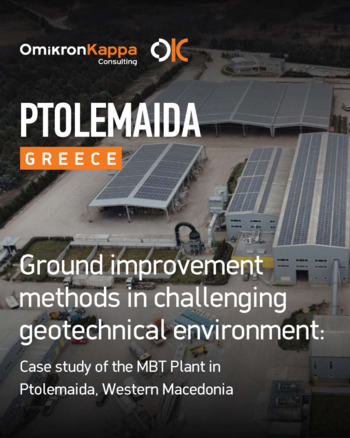
Ground improvement methods in challenging geotechnical environmental: Case study of the MBT Plant in Ptolemaida, Western Macedonia
August 31, 2026
Building a state-of-the-art waste treatment facility on 80 m of uncompacted mine waste?
Here is how geotechnical engineering overcame extreme soil uncertainty.
The Mechanical and Biological Treatment (MBT) Plant in Ptolemaida was built on a site consisting of waste deposits from open-cast lignite mining activities. Beneath the surface lay 60–80 meters of heterogeneous, randomly deposited fill—a chaotic mix of marls, clays, sands, and gravels.
To address severe risks of differential and long-term creep settlement, an integrated ground improvement strategy was implemented, combining surcharge preloading with deep prefabricated vertical drains (PVDs).
A comprehensive geotechnical monitoring program was implemented throughout the preloading process. High-precision settlement markers and vibrating-wire piezometers provided continuous data on ground movement and pore-water pressure development. The monitoring data was then back-analyzed to calibrate numerical geotechnical models, verify design assumptions, and assess the overall effectiveness of the ground improvement works.
The result? A resilient, structurally sound foundation built efficiently on highly problematic ground.
Swipe through the carousel to see the site conditions, engineering execution, and monitoring data step-by-step.